Weak Rock
For weak rock layers or IGMs (intermediate geomaterials), some simple methods for the estimation of the shaft friction and the tip resistance are presented in the following sections.
Shaft Friction in Weak Rock
The shaft friction along the part of the pile socketed in weak rock can be approximated by:
Many experiments were performed on weak rocks in order to determine the adhesion factor in equation \((\ref{eq:unit-shaft-resistance-wr})\). The experimental data and the line of best fit are shown in Figure 1.
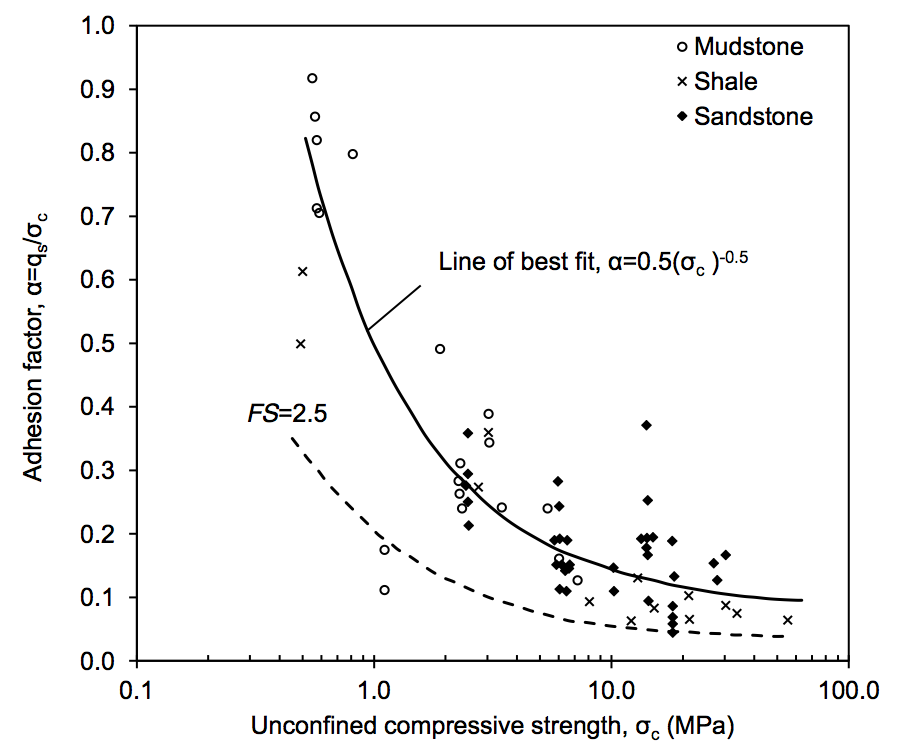
For practical purposes, the equation of the best fit line in Figure 1 is used for estimating the shaft friction of weak rocks:
General notes for shaft friction in weak rock
- Reference for equations \((\ref{eq:unit-shaft-resistance-wr})\) and \((\ref{eq:adhesion-factor-wr})\), and Figure 1: Wyllie (1999), pp.258-263.
- Ultimate unit skin friction \(q_s\) has a limiting value of 10000 kPa or 1450 psi for weak rocks.
Tip Resistance in Weak Rock
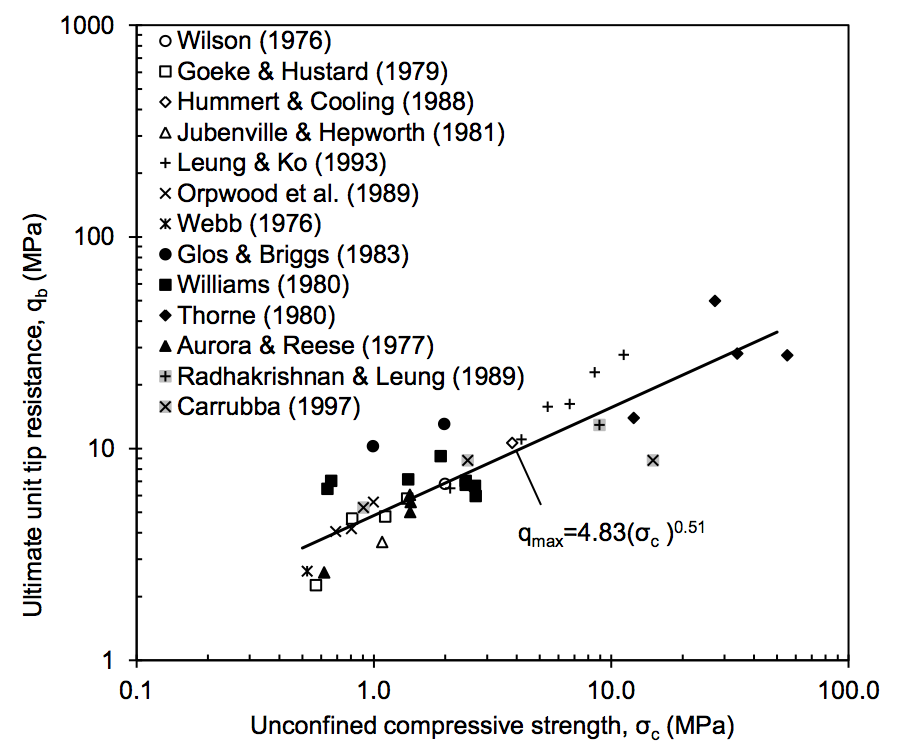
The tip resistance of a pile socketed in weak rock can be approximated with the following formula which uses a wide range of field test data (Figure 2).
General notes for tip resistance in weak rock
-
Reference for equation \((\ref{eq:unit-tip-resistance-wr})\) and Figure 2: Zhang (2004), p. 219.
-
Ultimate unit tip resistance \(q_b\) has a limiting value of 50000 kPa or 7250 psi for weak rocks. But the ultimate bearing capacity of rock sockets is generally limited by the compressive strength of the reinforced-concrete material inside the shaft.
We strongly recommend not to rely only on these simple approximations for pile bearing capacity in rocks, since there are many other methods which incorporate other crucial rock parameters such as the RQD, shaft roughness and the fracture structure at the rock socket, etc. See the Rock (Tomlinson) method for an alternative approach that incorporates RQD.