Tip Resistance Correction
Legacy Feature
The tip resistance correction described below was available in the original Piles Capacity iOS app. It is documented here for reference purposes.
Typical depth vs. bearing capacity graphs exhibit discrete change at layer boundaries, where the pile is just resting on (without any penetration into) a layer with different tip bearing characteristics.
Indeed this discrete change does not exist in reality due to the presence of the punching wedge at the pile tip, which is shown in Figure 4.
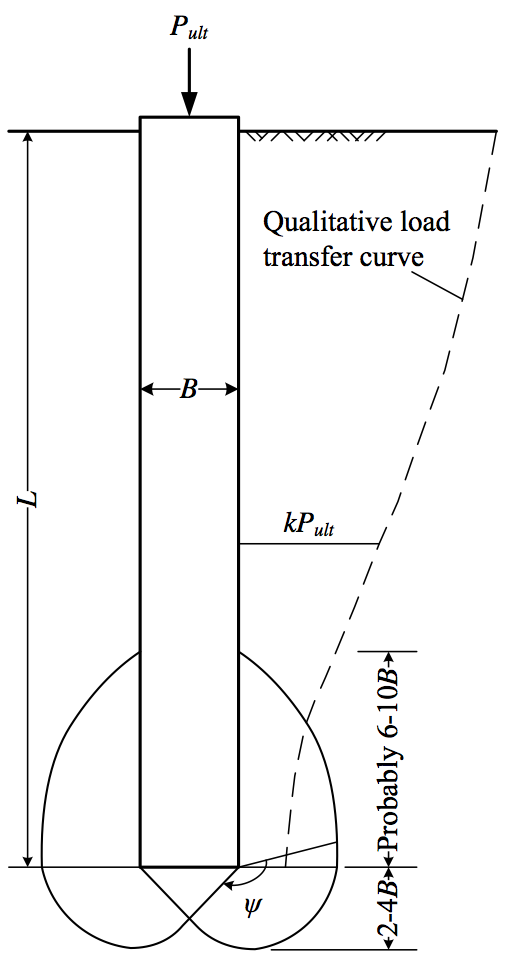
Considering this fact, we have implemented the tip resistance correction feature which allows investigating the effect of underlying soil strata on the end bearing resistance of pile.
When the tip resistance correction is enabled, the tip resistance graph is smoothed by linear interpolation between the tip resistance value of the pile resting on the underlying strata, and the tip resistance value at the level 3 times the diameter – median value for 2~4B from Figure 4 – above the boundary.
Figure 5 shows the depth vs. bearing capacity graphs for both cases where the tip resistance correction is disabled and enabled, respectively. In this figure, it can be observed that, the tip resistance values (shown with purple line) at layer interfaces (shown with dashed horizontal grey lines) and at a depth 3 times the pile diameter above those boundaries, remain unchanged, while the tip resistance values in between these two locations are linearly interpolated, either decreasing or increasing the original end bearing values.
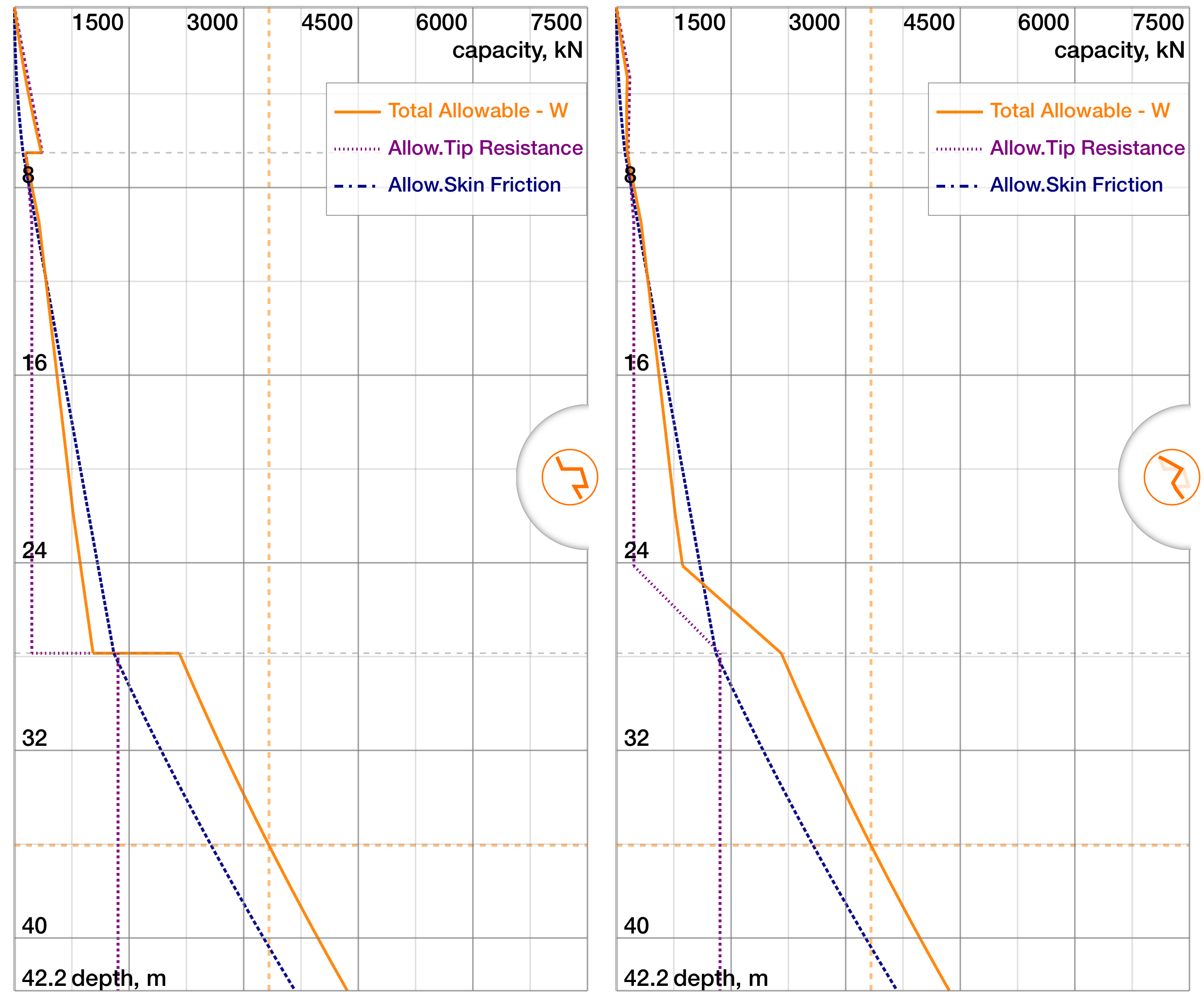
This feature was available in the original Piles Capacity iOS app, where it could be enabled by tapping a button on the graph. It was automatically disabled for cases when the current or the previous layer is Weak Rock or IGM for which any punching wedge is unlikely to occur.